Sunday, March 1, 2015

Trip to Peru (January and February 2015)...(Part I)

In continuation of the Spanish study, Kristin and I traveled to Peru after four weeks in Ecuador.

In total, we stayed in Peru for five weeks. During this period, we experienced a lot, but the noteworthy were Studying Spanish, Lima, Nasca Lines, Cusco and Machu Picchu, Puno and Lake Titicaca, Colca Canyon and Arequipa. Due to length, I am posting this travel log in two parts.

Studying Spanish
The primary purpose of the trip was to study Spanish. We learned that Peruanos speak the high class Spanish. We studied in group at Peruwayna located in Miraflores, Lima's famous tourist town. It provided us with convenient access to many attractions and restaurants, but we had to bear a lot of noise, even at night, and the crowd.


The class of the third week... Miguel, Mike from Texas, Kristin, Jeffrey, Andrew from Australia and Curt from Pennsylvania
The class of the first week... Jeffrey, Katie from Finland, Miguel, Mike from Texas, Egzi from Australia and Kristin


The school operated a little differently from Amauta in Cuenca. At Amauta, each teacher had flexibility in choosing his or her own teaching methodology and materials. Peruwayna, however, had printed books for each level of proficiency. Also, we were able to start the class without having to be tested because we were only students in our class, but at Peruwayna, we had to take a written test on line and an oral test on the first day. In Cuenca, we were able to stay with one teach for all four weeks without any other students, but in Lima, we had different students each week, except Michael who was a retiree from Texas and stayed in the class for all four weeks together with us.

Overall, I thoroughly enjoyed the learning at Peruwayna. It provided us with excellent printed books and the teacher, Miguel, was great with clear and correct pronunciation. He was handsome, intelligent and pleasant. He married to a German lady, Ute, and they have one little boy, Gustavo. Other than Mike and a few others, we were the oldest student among 30 some students who were learning Spanish at Peruwayna. I felt that my Spanish improved significantly while I was studying in Lima. so I am grateful. Miguel taught and showed us how to continue studying Spanish using materials that are available on line. That was also very helpful.

Lima
Church of Lima at Night
Lima is the capital city of Peru. It has a population of over 10 million in a country that has a total population of only 30 million. Peru is a country of a pretty good size geographically, but more than 50% of the land is Amazon jungle. Also, it has the Andes Mountains a large part of which is not inhabitable and usable. Moreover, along the long coastal lines, most of the land is barren dessert. It is one of the reasons for the capital city Lima to have the one third of the nation's population.

World Bank projects that Peru will be the largest economy in South America by 2025. Its projection is based on various factors, such as steady growths in tourism, its strongest attraction and minerals. Many still question its viability, but we will see what happens. For this reason, Lima's cost of living was far higher than that of Cuenca, Ecuador.

Lima is proud of its culture, particularly foods. Peruanos never want to accept any food culture of mediocrity. It could be bad in a sense that they cannot experience diverse food cultures of the world. They claim the ownership to the famous Ceviche.

Lima is located at the sea shore, looking over the Pacific Ocean. Miraflores has a shopping mall developed at a section of the cliff facing the ocean, namely Larcomar. There are dozens of restaurants where you can enjoy the sea breeze and the sunset, and many stores where you can buy all kinds of brands.

Sunset at Miraflores
Larcomar at Miraflores
Larcomar is part of Lima's El Malecon, a boardwalk on the cliffs which stretch a few kilometers along the coast. It attracts families, lovers, youth, as well as tourists. As you walk along the boardwalk, you can see low- and high-rise condominium buildings that are designed to maximize the ocean view for their residents. The walk to the Malecon was one of the routines for us in the late afternoon or early evening. We were able to enjoy Lima's beautiful sunsets several times. The last day, we were at Parque de Amor where you can find a statue of a lover couple. It looked romantic enough for many couples to find and affirm their love, in the backdrop of beautiful sunsets.
Statue of Kissing Couple at Parque de Amor
A couple at Parque de Amor at sunset
We took a half-day city tour and visited several places, such as Church of San Francisco and its Catacomb, Government Palace, Plaze de Armas, Huaca Pucllaha, an archaeological site for the Inca culture, a museum. We wanted to visit the so-called the largest water park complex in the world, but it was temporarily closed for renovation. Too bad.
Pre-colombian Cultures of Peru 
Lima City Hall
Government Palace
Church of San Francisco and Catacombs
We visited several places whenever we found time, such as Inka markets, street exhibition of arts, Kennedy Park where hundreds of cats interact with visitors, Mercado Surquillo. Of course, we tasted the famous Pisco Sour, an alcoholic drink made of pisco grapes. It was quite strong and we considered one trial enough. Also, we ate the famous Peruvian ceviche, basically raw fish with some seasoning and vegetables. It was okay, but was not as impressed as I have been by Aroz con mariscos which we both ate and enjoyed a lot in Peru as well as in Ecuador.
People with cats. The city takes care of these cats.
Pisco Sour
One of the Inca Market Stores
Street Exhibition of Art Paintings
Cuy Arts and Crafts
Mercado Surquillo
We also visited Barranco District, known to be Lima's Bohemian district filled with colonial style buildings and architecture. It was beautiful. We found ourselves liking colonial style over modern architecture. We attended a church started by an American missionary and another Korean church that was established 25 years ago. It was quite interesting to see so many Koreans, 150 or so, in one place, in a place like Lima. But I was thinking that people might have felt the same when they visited a Korean church in Kigali, Rwanda.

An indigenous woman carrying a baby

When you travel, you get to meet a lot of people. We met with a couple of Korean missionaries who are ministering to the people of Peru. Samuel Jaeyoung Kim was one and Missionary Choi was another. We rejoiced with each other over what God has been doing through our lives.

Next to me are Missionary Choi and Missionary Kim

It is joyous to meet new people, but the joy multiplies when you get to meet old friends. We bumped into Kristin's college friend couple from Baltimore in Lima, unexpectedly. They came to see Machu Picchu and Nasca Lines. After their trip to Machu Picchu, we found time to meet at Larcomar. It was a joyous and sweet reunion.


Nasca Lines
One of the places that I really wanted to visit was Nasca Lines. Prior to the Inca Empire, there were Nasca people who built the so-called Nasca lines. Nasca lines are more than 100 shapes and forms that exist on the high plateaus around a city called Nasca. Out of them, 70 or so take the forms of animals, such as eagle, monkey, parrot, humming bird, heron, whale etc. in various sizes. The largest one spans approximately 180 meters in width.
Art of the Nasca Lines
The most mysterious one, which still puzzles me, is an astronaut drawing on the side of an entire mountain. Astronaut in the 12th century? How did they imagine something like it... had they not actually seen one? Does that mean there are astronauts in the universe and they actually visited the earth several hundred years ago...? If so, why? How did they interact with the people on earth then? Why did they leave? Or... what? I later found out that the alien theory was one of tends of theories for why the Nasca people made such giant lines in high plateaus. Still, nothing stands out among them all. I am curious to learn more about any progress on these Nasca lines.
Monkey
Eagle
Astronaut
The way they created was by removing gravels and rocks from the ground, thus exposing the white- or ivory-colored underground dirt.

To get to Nasca, we took a Cruz del Sur, a bus liner that covers from Colombia to Brazil in South America. The price we paid for the tour included a VIP seating in the bus and it was the first class of the bus in the lower level of the double-decked bus. The leather-seats were wide and comfortable; Wi-Fi was working well; They even served a meal and a drink. Wow! I felt I could take a bus tour along the South American countries with Cruz del Sur. It was a memorable experience.


Many people travel to Nasca over two days. This two-day trip includes a visit to Paracas National Park and to an island. Also, they stop over in Ica, which is a Peruvian version of Napa Valley. But we chose to visit Nasca Lines in one day. So we took the bus to Paracas and was taken to the nearby Pisco Airport where we took the Sesna plane to fly to Nasca. The total round trip flying time was approximately 90 minutes, compared to 30 minutes if you fly out of Nasca Airport. Ironically, the two-day trip would have been cheaper without an overnight sleep.

To be continued in Part II that covers Cusco and Machu Picchu, Puno and Lake Titicaca, Colca Canyon and Arequipa.

Thursday, January 15, 2015

Trip to Ecuador (December 2014 and January 2015)

New Cathedral in Cuenca...
Kristin and I traveled to Ecuador in December 2014 for four weeks. The primary purpose was to learn Spanish intensively. We stayed primarily in Cuenca, but we traveled to other towns and cities over the Christmas and New Year breaks.

Learning Spanish

It is the most effective way to learn any foreign language in its own culture.

Learning Spanish in countries where Spanish is spoken has been on Kristin's bucket list for many years, probably 30 years or so. We chose to do it during this sabbatical leave and in Ecuador and Peru.

Amauta Fundacion
Among many cities in Ecuador, we chose Cuenca because: 1) it is in the Andes, meaning highlands and cool weather, 2) its cost of living is very affordable, 3) its population of a half million is large enough to have most of the amenities but small enough to be "manageable" and 4) it has the first class medical and dental services at the third world price. We traveled ten days in 2013 to explore several cities in Ecuador for this purpose.
With teachers for viejo ano (New Year's Eve)
We studied at Amauta Fundacion in El; Centro, downtown Cuenca. The Spanish learning was intensive with a 4-hour study everyday. Moreover, the verb conjugation was so complex that we were deeply frustrated. But we survived and learned a lot with much emphasis on grammar.

Our teacher was Isabel Tosi, in her 50's, who studied Spanish literature at the university and has been teaching Spanish for many years. Her slow speed of talking and great deal of patience with us helped us a lot. We developed a good friendship and agreed to stay in touch. We were the only students in her class mainly because we started during the holiday season, which is one of the slowest seasons. They organized several programs that were related to Christmas and New Year's Day.

With Isabel Tosi
Over Christmas, we held a gift-exchange program among all students. I found out that I was not the oldest student. There was Jonathan who was a retiree of the U.S. and was living in Cuenca by himself.

Over the New Year's Eve, or Ano Viejo in Spanish, the school organized an event in which people gathered to burn a paper puppet to ridicule any undesirable situation of people. One of the owners of Amauta had inflammation on her elbow and teachers and staff gathered to ridicule and burn a paper puppet that looked like carrying the inflammation. That was a custom in Ecuador of wishing the good-will for people. They jumped over the burning puppet and it was the way to ridicule the puppet that carried the little disease of the co-owner.

Cuenca

In front of the New Cathedral and Parque de Calderon
Cuenca is the third largest city in Ecuador, following Guayaquil, the commercial capital, and Quito, the state capital. Also, it is one of the UNESCO's World Heritages. Cuenca's colonial architecture is just beautiful. Cuenca's representative structure is its new Cathedral. Its blue domes stand out even in a distance and its huge structure matches well with the Parque Calderon in its front. People gather in the parque and merchants flock in the vicinity to attract their clients.
Azuay Governor's Office and colonial buildings

The city has four rivers that look like streams during the dry season but swell high during the rainy season. Isabel told us that during the rainy season people can hardly survive the deep current if they fall. Along the rivers, jogging and walking trails have developed and their beauty and serenity have naturally attracted developed to build residences along the rivers.

Parque de Calderon in front of New Cathedral
We enjoyed sea food with rice, or Arroz con mariscos, a lot. It was our favorite food. But we also enjoyed other foods, such as ceviches, almuerzos, chicken dishes and shrimp dishes. The foods were delicious, but their prices were even better.

While we were in Cuenca, we intended to live with a host family. The idea was to learn the family culture and practice Spanish more. But our host family consisted of a single mom with two children. They wanted to practice their English more and their English was far better than our Spanish. Naturally, we rarely had opportunities to interact most of the days during the week. Moreover, the bed was too small for two of us to sleep comfortably. So we ended up changing out lodging to a hostal or a guest house. It ended up costing us a little more than the original budget, but it was worthwhile.
Hostal Emilia where we stayed for 9 nights

Cuencanos hold a parade, called Paseos de Ninos (Passage of Children) on Christmas Eve. We learned that it is the largest in Ecuador, if not in the entire South America. Unfortunately on this past Christmas Eve, there was a rain, but all participants did not care. Fortunately, the rain stopped soon after the parade began, I heard. We did not see the parade because we traveled down to Vilcabamba over the Christmas break for three nights.

Vilcabamba

Vilcabamba is located approximately 250 km south of Cuenca and 45-minute from the capital of the province, namely Loja. It has a population of only 5,000, but it has attracted people's attention for quite some time. It is because of its beauty surrounding the town and the fact that the town has many people of longevity. Many people live beyond 100 years of age. No wonder that Vilcabamba is called "Town of Longevity."
With Greg and his wife

We traveled to Vilcabamba over the Christmas break in a small SUV for four hours through winding and curly roads crossing over the Andes mountains. There were several "close-moments" based on my standards. But the driver did not care. We were relieved when we arrived at Madre Tierra or Mother Earth, a high-end guest house. It had a sub-title of Spa and Resort, but it was not what it implied. It was rustic although the setting and surrounding were beautiful! We felt so relaxed and well-pampered there.

The place was managed by a couple who moved from Washing state in the U.S. They must be in their 50's and said that they moved to Vilcabamba three years ago. They intend to live there for a long term as part of their mission work.

They had one teen-aged daughter and she was educated through home schooling. Her mom was grateful that she was disciplined enough to follow the curriculum without failure.
From the swimming pool


We drove around the town and there were several mansions or big houses that are owned by foreign expatriates. Some retirees settle there for various reasons, but primarily for a relaxed, healthy and simple life style. It was too "boring" for us, but we thoroughly enjoyed our 3-night stay.

I have not been to Shangrila, but I was suspecting that it would look like Vilcabamba. Vilcabamba was that much beautiful.


Salinas
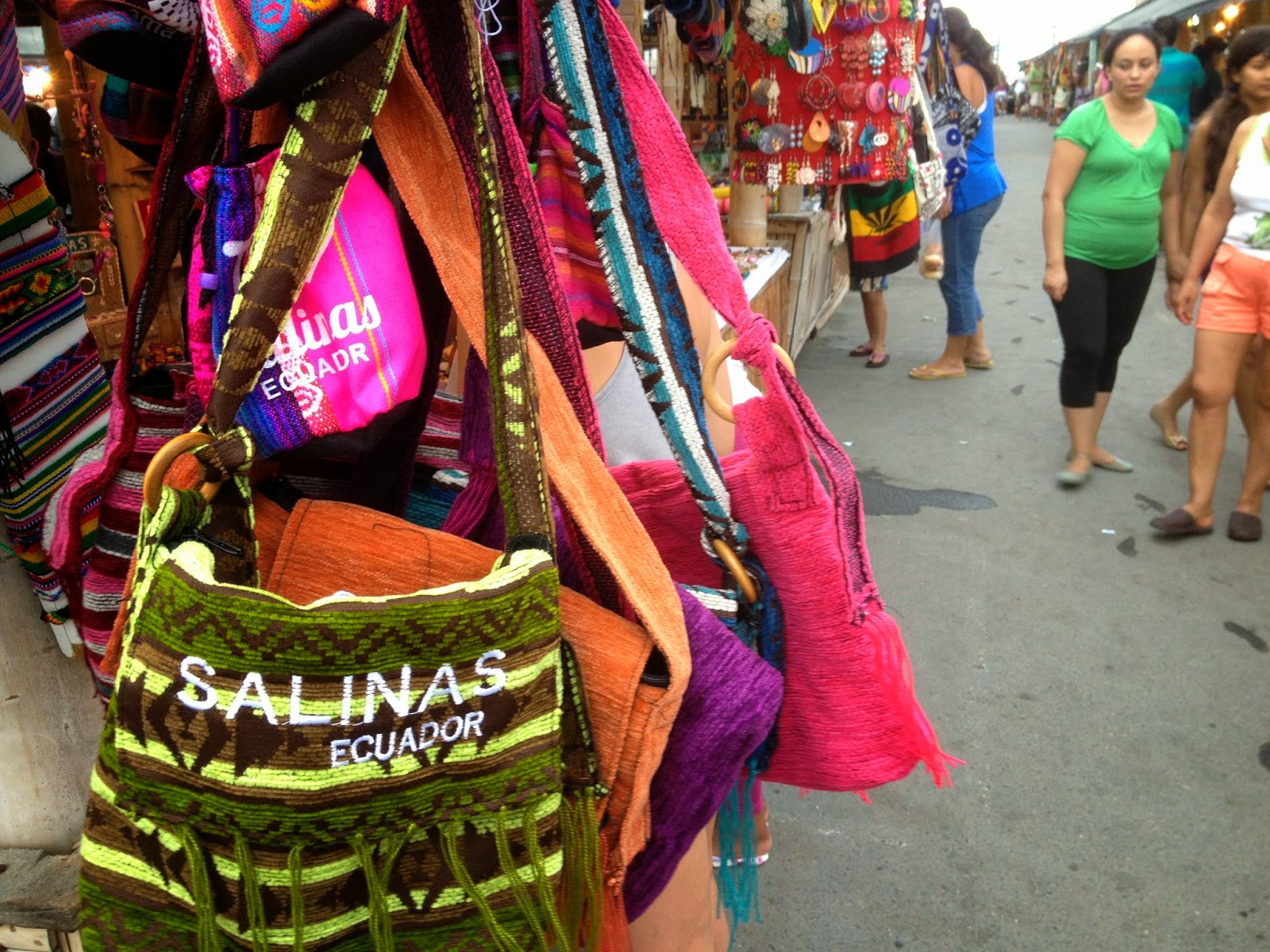
At a local street market
For the New Year's break, we chose to travel to Salinas, the most popular coastal destination to a lot of people from Guayaquil and other cities. It reminded me of Miami, of course in a lot smaller scale. It had many high-rise condominium buildings along the boardwalk or Malecon and the entire town, let alone the beach, was packed with people. We stayed at a hotel approximately 15 minutes away from the beach, but the entire city went crazy on the New Year's Eve with fireworks exploding everywhere the whole night. Even the New Year's Day suffered from explosive noises. I suppose it is the custom of the city and the country and there is nothing we could do about it. It was hot and muggy, and we felt that our decision was not so smart this time.

Nonetheless, we enjoyed our time over there with foods, walking and looking around.

On return, we bumped into this llama family on the road
Traveling to Salinas was not as seamless as the trip to Vilcabamba. We had to travel first to Guayaquil via a mini-van that was a bullet vehicle with several scary moments. From there, we had to take a taxi to Salinas. We initially planned to take a bus, but the ticket line was far too long to wait. It set us back $60 but it was worthwhile.

Paper puppets to be burned on New Year's Eve
On return, we took a taxi to the bus terminal and took a bus to Guayaquil. It cost us only $3.30 for the 2-hour bus ride but the bust was air-conditioned and very comfortable. So, we planned to take a bus from Guayaquil to Cuenca as well. But again, the waiting line was far too long so we ended up taking a mini-van. Fortunately, this time the mini-van driver was not as wild as the previous mini-van driver. Nonetheless, the vehicle had a mal-functioning windshield defroster while the roads were foggy for at least half of the trip. I was sitting next to the driver and felt just uncomfortable with fuzzy front view. Thanks to God's grace, we came back to Cuenca in one pieces.

A street scene of the New Year's Eve burning
This and That

We had a reunion with Dave and Kristy who were also on the 10-day Ecuador Crash Course that we were on in 2013. They had moved to Ecuador soon after the trip in 2013 and have since been living in Cuenca. It was a great joy to see them again. They shared their experiences of relocating to Ecuador and using medical services.

We also met Frank and Angie who moved from the U.S. to Cuenca four years ago and have since been writing countless number of blogs and even books for "do in yourself" to relocate to Cuenca, Quito and Costal cities. They have emphasized on "going local" for the expatriates and our get-together over lunch was a joyful one.

I met with Pastor Bolivar and later his wife Ximena. Both are Ecuadorians and have been missionaries to Guatemala and El Salvador. Now they provide marriage counseling services for Cuencano couples and share the gospel. They also run a church where believers gather to worship God and also a day-care center for children of the couples who come for counseling and worship. Our meeting was fruitful and we would stay in touch. Missionary Youngmin Lee, who was a missionary to Ecuador for many years and was in Korea to take care of his ill wife at the time of our stay, introduced me to Bolivar.
With Bolivar and Xemina

On the way to Lima, Peru, we had to travel via Quito. At the Quito Airport, we had a short but sweet reunion with Sarah, who organized the 10-day Ecuador Crash Course. She is a nurse and volunteered in Ecuador as a Peace Corps volunteer. She has since married a Ecuadorean military officer and has been living in Quito for a few decades. It was a great joy to see her in action again. She is such as pleasant woman always with an upbeat spirit.
With Sarah at Quito Airport

We also purchased my allergy pills and Kristin's blood pressure pills in Cuenca. The products were reliable but the price was much lower than in the U.S. We also used dental services in Cuenca for cleaning and some repair works. The dentist, Cristina Tosi, Isabel's niece, was very pleasant and detailed in her service. She was running a dental office by herself. Again, the service was good and the price we paid was much lower than we would have paid in the U.S. for the same service.

While we were in Cuenca for four weeks, we attended three churches: Centro Cristo de Cuenca, The Gathering and International Christian Community. They all offered unique services, but we were grateful that we were able to worship to God with His people in Ecuador.
With the pastor David at International Christian Community

I met with a lawyer, Rodrigo and his associate Maria, to inquire about the requirements for the resident visa. The meeting was fruitful.

On the last day in Cuenca, we drove around the city and its neighboring towns, such as Paute, Challuabamba, Valle de Rios. We liked Valle de Rios very much, which had a housing developing along the river.

Overall, we thoroughly enjoyed our 4-week stay in Cuenca with a lot accomplished during this time period.

We thank God for His grace in allowing us for this trip. Praise the Lord! - Amen.


Friday, November 21, 2014

Trip to Cambodia and Thailand (November 2014)

I made a quick trip to Phnom Penh, Cambodia in November (12-15). The purpose of my trip was to talk about "Microfinance for Sustainable Development" to an audience of 300 people from all walks of life. I was one of six speakers for a conference organized jointly by Handong Global University (HGU) and National Bank of Cambodia (NBC). My attendance was in the capacity of a faculty member of HGU.

The theme was "Improving the Management and Financing Competencies of Small and Medium Enterprises (SMEs)" and the conference was supported by UNESCO's UNITWIN (University Twining and Networking) program. HGU is the only hub university in Korea for the UNITWIN program.


This one-day event may not be remembered for long by many people because I felt the conference could have been better organized. But it gave me a golden opportunity to visit Cambodia for the first time and unexpectedly I was able to meet up with missionary Insong Kim who is being supported by Logos Central Chapel, Denver Colorado. He is running Jesus Mission.

Missionary Kim, local pastor, Mrs. Kim


My first impression of Cambodia, more appropriately Phnom Penh, was that the country was poor, predominantly agriculture; the people seemed friendly; the street traffic seemed pretty chaotic and disorganized. Also, I have heard that the corruption level is very high and it holds down the country's economic progress that many citizens long to see. I was told also that the Chinese people living in Cambodia control a significant portion of the national economy, particularly the distribution system, thus blocking competition and free market dynamics.

I learned that ASEAN (Association of South East Asian Nations) will open up their borders to make the flows of resources (capital, human, technology etc) among the member nations. It appeared that Cambodia was concerned about adverse impact that the free flow of resources may bring to the country. The conference was put together in an aim to bolster the competencies of SMEs to better prepare for the upcoming competition.

Gathering with people who have interest in BAM

This trip to Cambodia also gave me a golden opportunity to visit Thailand. The airfare to Phnom Penh only was more expensive than an itinerary that includes another stop over in Bangkok. So I took advantage of this extended trip to visit with a business missionary Lee, Hyun Guk whom I met at BAM Consultation 2013 and 2014.
Business Missionary Lee

This trip turned out to be a wonderful experience of meeting several BAM practitioners and providing some assistance. Also, I met up with several missionaries and young adults who are keenly interested in BAM for one reason or another. I felt greatly encouraged to hear of their desire and also their request for me to come to help them. I consulted a few young BAMers and spoke to dozens of Thais who worship at a church started by a Korean missionary, Young Sung Park, who is also trying to incorporate BAM ideas into his ministries.
Missionary and Mrs. Park after service

15 recipients of scholarship

After talking about "Living the life of Light of the World"

Mandy from Colorado, a high school graduate

A couple of young BAMers
Obviously I was indulged significantly with excellent delicacies of Thai food thanks to the great hospitality of the missionary Lee and missionary Hong, Jung Hyun. They were exceedingly hospitable and I felt indebted to them. Hong was reaching out to students on college campuses under the umbrella of Students for Christ (SFC). He served in the Philippines for nine years before he came to Thailand to start up a new SFC.

His wife was a BAMer. Through her business, namely Nebia House, she was making fabric toys that were exported to Korea. Missionary Lee has helped greatly for the business to be shaped and take off with the products that are commercially salable. Through this business, many people gained jobs and consequently higher income. There were not only direct beneficiaries of this BAM, such as people who work directly for Nebia House, but also indirect beneficiaries who were able to earn income through outsourcing. Church pastors were delighted to see their congregation members earn income.


Missionary Hong and Mrs. Hong

One of the products Nebia House sells

Noteworthy was another BAM, called Samaritan Creation, started and run by an American missionary Mike who married a Thai lady Kay. They make fashion jewelry, fabric toys and fly fishing baits. Their ministry is to help the prostitutes leave their night life and start a new life through normal employment with Samaritan Creation. Samaritan Creation is one of the Nebia House's outsourcing suppliers.
Kay and Mike


All in all, I have come back to Rwanda with greater conviction of the positive impact that a BAM produces when it is properly run based on biblical principles. I have become more assured of God's calling for me to be involved in BAM. Moreover, Thailand may be a place to help bring the gospel to the nations in Indochina where Thailand is situated at the center. May it be true and a reality! Praise the Lord!

The last day, we were able to visit some places of interest, such as a fruit farm, a market on the water and a beach near Pattaya due to my midnight flight schedule. Again, I appreciated the kind escorting and guide of Missionaries Lee and Hong. - Jeffrey