Sunday, April 29, 2018

Da Nang and Hue, Vietnam (March 2018)


After two nights of stay in Hoi An, we passed through Da Nang. Da Nang is the third largest city with the population of 1.4 million, after Ho Chi Minh City (8.6 million) and Hanoi (7.6 million). Da Nang is a coastal city with long and wide sand beaches. The beach stretches over 15 km. Also, the climate is mild and is known to be the best town for retirement. Hmmm... That sounds interesting. The temperature is 10 degrees cooler than Ho Chi Minh City. We stopped over at a beach site for taking a picture. In distance, we saw a 40 meter tall statue of a Buddha, called Kwan Ying or Kwan Eum. It is understandable given that 80% of Vietnamese people are Buddhists. Christianity accounts for 10% and the rest Taoism and Confucianism.


Before we arrive at Hue, we drove by the Marble Mountain and stopped over at a shop where a lot of handmade marble products were displayed.


The pathway from Da Nang to Hue included winding roads and a long tunnel to pass through towering mountains.The tunnel is 5 mile long, built by the Japanese in 2006. Without the tunnel, you should drive for 1 1/2 hours. It was a two-way road without a shoulder and I was wondering what if a car stops in the tunnel...?

We made a stop over at a site that was covered with used motorbike tires. Obviously, their use is not beneficial to the water eco system, but ironically the scenery was tranquil and beautiful.


Hue used to be the imperial capital of the Nguyen Dynasty from 1802 - 1945. Hue was built after the Forbidden City of Beijing, but it is now a small town with a population of less than 400,000, but it still has Dai Noi Citadel that is surrounded by a moat and thick stone walls. It encompasses the Imperial City with palaces and shrines.

We passed through the main entrance of Ngo Mon Gate. We also passed through Thai Hoa Palace, the Halls of Mandarins, Nine Dynastic Urns and Forbidden Purple City ruins. Hue had a nick name of the Purple City because of the color purple was widely used.


In the evening, we joined the optional Trishaw (Cyclo) Ride to the dinner. It was a scary ride particularly at hte intersections where a lot of cars, motorcycles and cyclos are comingled to pass through without traffic signals. Moreover, fumes coming from all the cars and motorbikes were quite bad. We all wore masks, but they were surely not good enough.


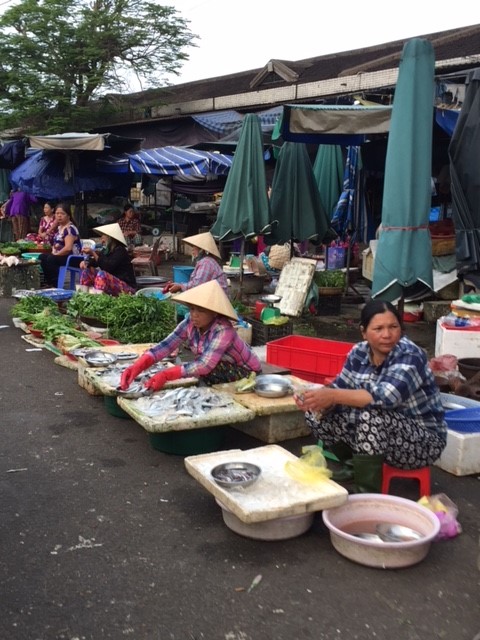
The Cyclos went through a traditional market where we saw many merchants selling fruits and veggies.



The dinner was at a private house, probably former general or similar status with big house and many dining rooms. We were told that the foods we ate were the replicas of royal cuisine with a lot of decorations. I would say that the taste of the foods was not as good as the presentations. On the way back, we took a mini bus instead of the Cyclos. Whew...


The following day, we joined the optional tour of Perfume River Cruise. Along the river, there are many flowers which provided fragrance, hence the name. The excursion on a double dragon head boat included the exploration of the life along the banks of the ancient royal capital city. These types of dragon boats were used by the Royal Family on festive days. The gentle perfume river, supposedly blue in color but not really in reality, is dotted with a poetic landscape of boats, gardens, pagodas, towers and temples. Our excursion stopped over at Thien Mu Pagoda on the north bank of the river. It was built in 1601 and in seven consecutive tiers.


The excursion also stopped over at the Tomb of Emperor Tu Duc, the final resting place of Vietnam's longest reigning emperor and to Khai Dinh, the last monument of the Nguyen Dynasty. We saw a lot of bonjai plants. We ate a vegetarian lunch prepared by Buddhist nuns of hte Dong Thien Pagoda. Not so impressive.


We stopped over at a place that makes incenses to be used at the temples. Also, we visited a tomb of a king called Teuk Leuk. This was one of seven such tombs in Hue.


Our trip to Hue was short but covered a lot. The city may not be able to recover the past glory as the imperial city, but its citadel will surely remind the visiting tourists of the golden time the city enjoyed in the past. - Jeffrey

Hoi An, Vietnam (March 2018)


From Ho Chi Minh City, we flew to Da Nang and by bus drove to Hoi An.

Hoi An is located in the central Vietnam and is well known for its well preserved ancient town. In Hoi An, Vietnamese ladies still wear their traditional "Ao Dais." Its ancient past is superbly preserved in an enchanting collection of temples, pagodas, shop houses and magnificent private homes in the town's Old Quarter.

Hoi An used to be a major international port city from 15th to 17th century. But, the port has become too shallow for big ships to dock due to the sands and muds that accumulated over time from the rivers flowing into the sea at Hoi An. It now is a small fishing village.

Hoi An was designated as a UNESCO World Heritage site in 1999, but it has since been commercialized with increased tourism.

We took a guided tour, that included visits to Temple, 400-year old Japanese Covered Bridge, River Walk and Ancient Town. Unfortunately, the photos taken from this guided tour have been misplaced. But the temple had a picture of Yubi, Gwanwoo and Jangbee who made a pledge for brotherhood at a peach garden. and a big statue of a dragon. The Japanese Bridge was not so impressive. So nothing much is missed. But I have borrowed a few photos from Google.


Hoi An was so crowded with Korean tourists. Overwhelmingly more than even Chinese tourists. I asked why. Because Korean Air has recently opened a direct flight from Incheon to Da Nang. That is why. Wow... But this impression continues throughout the tour in Vietnam. Koreans go everywhere.

Hoi An is called the city of lanterns. In the evening, the whole city is lit with lanterns and it is quite beautiful.


The following day, we had a quick trip to a beach nearby, called Hailing Beach, but the sand beach was quite narrow. Nonetheless, we had Tiger Beer under Coconut Trees, enjoying the sea breeze.


We joined an optional excursion on the Thu Bon River. An 81-year old man was showing off his rowing skills on a bamboo boat by circling around. Also, we watched a fisherman throwing his fish net. It was a Kodak moment. The excursion included a cooking demonstration at an Traque Organic Village and a 7-course lunch. It was a wonderful experience. Kristin volunteered to be a co-chef to make The food was quite good also. Also, we stopped over at Kim Bong Village where we visited woodworking shops.


I found a picture that shows Vietnamese fishermen using manual nets at shallow water to catch fish. I do not know how effective this fishing method is and how hard it is to catch fish this way, but the scenery was surely beautiful.


As we were passing through a Kim Bong Village, I saw a boy so absorbed into watching probably a video in a smart phone. He looked so intense and he portrayed the scene of modern children.


We stayed at a resort hotel called Hoi An Trails Resort with great satisfaction.


Hoi An was beautiful in the evening with the colorful lanterns.