This is Part II of the blog for Trip to Peru.
Cusco and Machu Picchu
 |
| Machu Picchu from the vista point before the entrance |
The highlight of our trip to Peru was obviously Machu Picchu, the place that is so famous that people automatically think of this place when they hear someone is going to Peru and express their envy. It was beautiful and its architecture was impressive, particularly for the fact that it was built on top of a mountain, 2,430 m high. But, I realized that the Inca Empire was not as old as it appeared or as I was led to believe it was. It was built in the 15th century, the medieval times. Should we be impressed by the somewhat crude architecture built during the medieval times while there are architectures and structures like the Pyramids of Giza, Roman amphitheaters, Greek ruins, all of which were built before Christ? What about the Ottoman Empire's gigantic structures built long time ago...?
At any way, the reality made me adjust my expectation, leading to disappointments, but at least I came to realize why Machu Picchu might have become so sensational as a tourist destination. I think it is because of the surroundings in the midst of which Machu Picchu is located. The surroundings were breath-taking. It was too bad that I did not have the wide angle lense to use and there was limitation for what I could take, but some photos that I took will show how beautiful the surroundings were.
I did not get to do the Inka Trail nor hike up to Wayna Picchu, the summit of Huayana Picchu, or to the summit of Machu Picchu Mountain, for various reasons, but I did not feel that I missed a lot. I walked part of the Inca trail, including a narrow tunnel through a rock. I could not imagine how people would have transported their kings or Incas on the narrow trails. Hmmmm...
 |
| Surrounding mountains seen from Machu Picchu |
 |
| The Sun Temple |
 |
| At Eagle Temple |
 |
| Another view on the way down from the entrance |
 |
| On the way down from Machu Picchu |
 |
| After the walk-down |
 |
| Museum that many people do not even know exists |
 |
| After the visit to Machu Picchu before leaving... |
The trip course to Machu Picchu was a little complex. Part of the rail ways was destroyed by a flood and we had to take a train from Ollataytambo to Machu Picchu station. From there, we took a bus to go up to the entrance. In the return trip, we decided to walk down, rather than taking the bus, and we were glad that we chose to walk. At the feet of the mountain, we found the site museum where I was able to see a photo of Machu Picchu in 1912, one year after it was discovered by a Yale professor Hiram Bingham thanks to the help of a boy, called Paulito. We also had a quick visit to a botanical garden next to the museum. Because we decided to walk down, we were also able to enjoy the beautiful scenery a lot more fully than sitting in the bus. The river was full and the current was rapid. It sounded like it was warning people not to destroy the nature any more.
 |
| Machu Picchu in 1912, one year after the discovery |
Cusco has its own attractions, such as Plaza de Armas, Qoricancha (Temple of the Sun with the Court of Gold), Cathedral, Inka Museum, Sacsayhuaman, another ruin with gigantic stones, Quenqo, a mummy-making site, Tambomachay, a never-ending spring. Cusco is located at 3,400m high. A sudden ascent to this height from the sea level created a little dizziness and light headache. We were able to sustain the altitude sickness by drinking coca tea and moving slowly. The following day, we toured to Sacred Vally where several Inca Empire sites can be found. We visited Ollantaytambo, Pisaq, including Pisaq Market.
 |
| At a restaurant looking over Plaza de Armas on a rainy day |
 |
| Ollantaytambo |
 |
| Alpaca, different from Llama, Vicuna, Guanaco |
 |
| Sacsayhuaman |
 |
| Selfie with Cusco in the background |
 |
| At the Pisaq Market |
Puno and Lake Titicaca
After we finished the 4-week Spanish course in Lima, we purchased two tour programs back to back. One was a tour from Lima to Cusco and to Puno. The other one was from Puno to Colca Canyon and to Arequipa. There was no company that covers the entire journey.
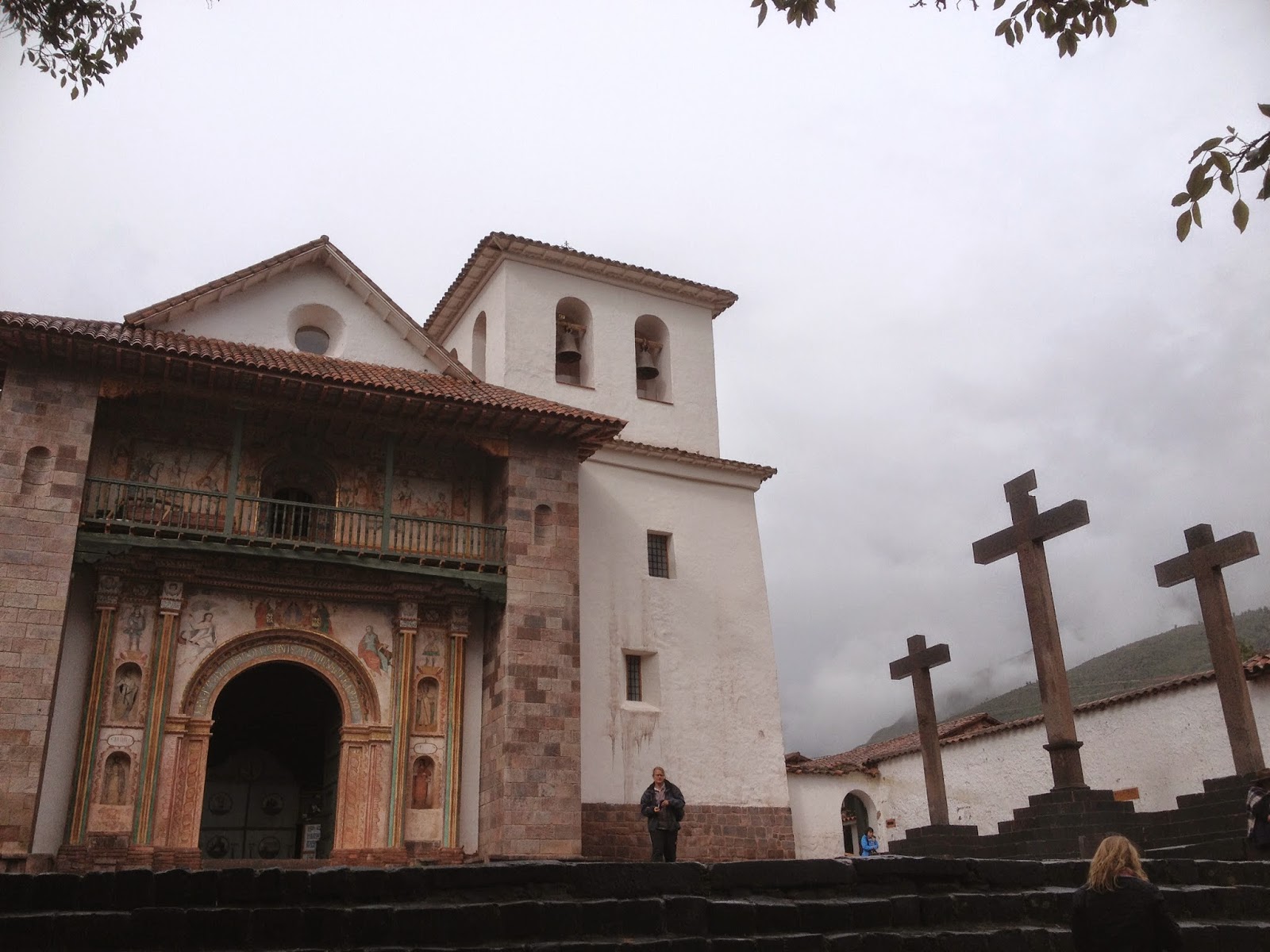 |
| St. Peter's Church at Andahuaylillas |
 |
| A mountain scene from a restaurant over lunch |
 |
| A torino idol at Pukara |
 |
| Puno Cathedral on a rainy day |
We had to leave Cusco early in the morning and took a bus, Inka Express, to travel to Puno. It would have taken approximately six hours to Puno if we had gone there direct, but the bus stopped over at several places on the way. We visited a St. Peter's church located in Andahuaylillas, an archaelogical site in Raqchi, a museum in Pukara.
What was quite interesting to me was Raqchi because the site was a temple for the God Supreme, the only one existing during the Inka time. All other temples were built for many other gods, such as Puma, Eagle, Snake, Sun, Moon, Stars etc., but this one is the only site for the Creator God. Isn't it interesting? Where did they get the idea of the Creator? The tour guide was talking about their belief in three phases of life that circles from puma, the earthy life, to snake, the wisdom left by the elderly people, and to eagle, a messenger of spirit to another life. They refer these three phases to the present, the past and the future.
 |
| Raqchi Site |
The lunch at a buffet restaurant by the river was a memorable experience. A musician was playing Peruvian music lonely and a painter was working on his art pieces in the garden.
Puno is a city with approximately 150,000 people in population, by the Lake Titicaca, meaning 'grey puma.' This lake is shared by Peru at 60% and Bolivia at 40%. The tour guide said that Bolivia claims the other way around. Anyway, the lake is the world's second highest navigable lake at 3,800 m high. after one in Venezuela. The lake is 8,300 square km and twice as big as Puerto Rico, the tour guide claimed. The deepest point is 300 meter.
 |
| Lake Titicaca Map |
Our hotel was located right next to the cathedral and people were still performing their brass band musics as part of a festival, nationwide famous, to celebrate a virgin. It was raining but people were still performing. This performance continued the following day with parades attended by a lot of young girls. I suppose they represent the virginity.
The following day, we took a speed boat and visited two islands. The first one was Taquile Island. In this island, 3,000 inhabitants are living, still keeping their long traditions. This island has no crime and no police. They do not have divorce either because a man and a woman live together for a few years to try out their marriage before they actually get married. Males and femals wear caps and gowns that indicate if they are single or married. What was interesting was that males have to learn how to knit and weave to get married. It was common that males do the hand-knitting at the corner of the plaza. They did not have the electricity until recently they installed solar panels to enjoy even DirecTV.
 |
| On the way to the Taquile Plaza |
 |
| At the Taquile Plaza |
 |
| Entrance into the Plaza |
 |
| Red and White means that he is single, knitting |
 |
| He is not only married but an authority |
 |
| Woman also covers her hair |
 |
| Traditional weaving frame |
After our visit to Taquile, we visited a few floating islands where the Uros people are living. These floating islands are made of reeds and reed roots. Normally it takes about a year to build one island and it lasts 25-30 years. The Uros have been living on the lake, literally, since the pre-Inca Empire. The Uros Community, as they are called, comprises 42-80 islands (two statistics are different) and is administratively under the City of Puno, but with autonomy. Each island has 3-5 families, totaling 10-15 people. Each island has a leader, usually taking turns and comprise extended families. The island we visited had 3 families of 15 people. All men were out for fishing and one woman and three girls greeted us. They showed us how to make the floating island and also sang songs in several languages. They took us out on the so-called Mercedez-Benz version of their boat, charging us 10 Peruvian Soles, $3.30, after the tour. The girls also entertained us with songs and let us taste the reed, which they eat regularly as snack. They had only one cat, but others raise dogs and chickens also. The islands are tiny, but they have their houses, their gardens, their storage rooms and backyards. They have to get on a boat if they need to go to a washroom or a restroom. Hmmmm... how do they handle the emergency situation...?
 |
| 8 men can make this boat in one day, but it lasts for 8 months |
 |
| Almost entire island in this photo |
 |
| The boat made of reeds with the beautiful background |
 |
| This 7-year old girl sang in 7 languages |
Colca Canyon
Early in the morning, we were picked up by another tour company. There were only four people, along with another American young missionary couple who are living in Cusco and us. The tour guide explained to us that after four hours of traveling, we will change the vehicle to a regular bus at Patahuasi, a crossroad where they switched the passenger traveling to different directions.
On the way, we saw a few flamingos, not a big deal after we saw hundreds, if not thousands, of flamingos in Africa, and stopped over at a high point of 4,911 m high where we could see eight volcanoes in the area. All of them were over 5,500 up to 6,200 or so. All snow-capped. It was one of the highest points for a car to pass.
 |
| Volcan Ampato at 6,288m, the tallest in the area |
On the first day we arrived in Chivay, a small town inside the Colca Canyon, we were taken to a hot spring, called Calera Hot Springs. We were given approximately 90 minutes to enjoy the warm mineral water that smelled strong sulfur. Our tired body needed it. People were ziplining over the canyon while we were dipping our body in the pool.
 |
| Dipping into the mineral-rich hot springs |
The following day, we had to start early to go up to Cruz del Condor, an observation point to spot the Peruvian condors that are rising and gliding in the Colca Canyon. El Condor Pasa was composed with the inspiration of the gliding condors here. They are part of the vulture family, really disappointing fact that I got to know, and their wing spans as wide as 3.2 meters. They become adults after 2 years of care and move out to be independent. For this reason, the condors hatch their eggs only every 3 years. After a lot of waiting, I was able to spot 3 condors in different angles. Only with iPhone, my photo-taking was somewhat limited, but it was enough to hum the song, El Condor Pasa, and remember the moment that we enjoyed the song so much during our college times.
 |
| The Cross at Condor Cross |
 |
| Humming El Condor Pasa |
 |
| Adult condor gliding into the canyon |
 |
| Adult condor soaring into the sky |
On the way there, we stopped over at town where young girls were dancing and I took a photo with an eagle on my arm. Also, on the way back, we stopped over a few other places, like a church and valley vista points.
 |
| With an eagle on my arm in early morning |
 |
| Young girls dancing with colorful skirts |
 |
| A selfie at a small town |
 |
| An old church beautifully harmonized with the cloud |
 |
| A couple photo at a visa point |
Arequipa
We went to Arequipa, the second largest city in Peru (1,000,000 people) is known to be 'The White City' because the white color of the old buildings. We stopped by the Plaza de Armas and walked around romantic streets where cute restaurants were located. Ah... I tried their flavor, cheese ice cream. Well... I could not tell much difference, but I tasted it.
We took a flight from Arequipa to Lima where we stayed another night. We flew Peruvian Air and thoroughly enjoyed it. When we purchased the tour programs, the travel agent, Travel Max (a good one that I can recommend to anyone interested in traveling to Peru) was cautioning us that the airline could cancel the flight. After we experienced African flights, particularly Kenya Airways and Ethiopian Airlines, Peruvian Air was just fine.
After one night stay in Lima, we began our long journey back to Rwanda: From Lima to Quito, first. From Quito to Amsterdam. One night stay. Then, from Amsterdam to Kigali. Well, we are now used to long flights, but the worse part was that I had to fly out via a red-eye flight on the day we arrived in Kigali. That twist, combined with Ethiopian flights, caused me to get sick. But, after all, we thoroughly enjoyed our trip to Peru, with deep gratitude to the Lord who has enabled us to. We praise you, Lord! - Jeffrey


