Sunday, October 24, 2010

Maputo, Mozambique (October 2010)


[A gorgeious sunrise that I luckily took at 5Am on one morning. It took only seconds for the sun to rise.]


[Cathedral that stands lofty downtown.... The Iron House designed by Mr. Eiffel, but unlivable because of the heat and humidity since it is made only of steel. Now it is a heritage center.]


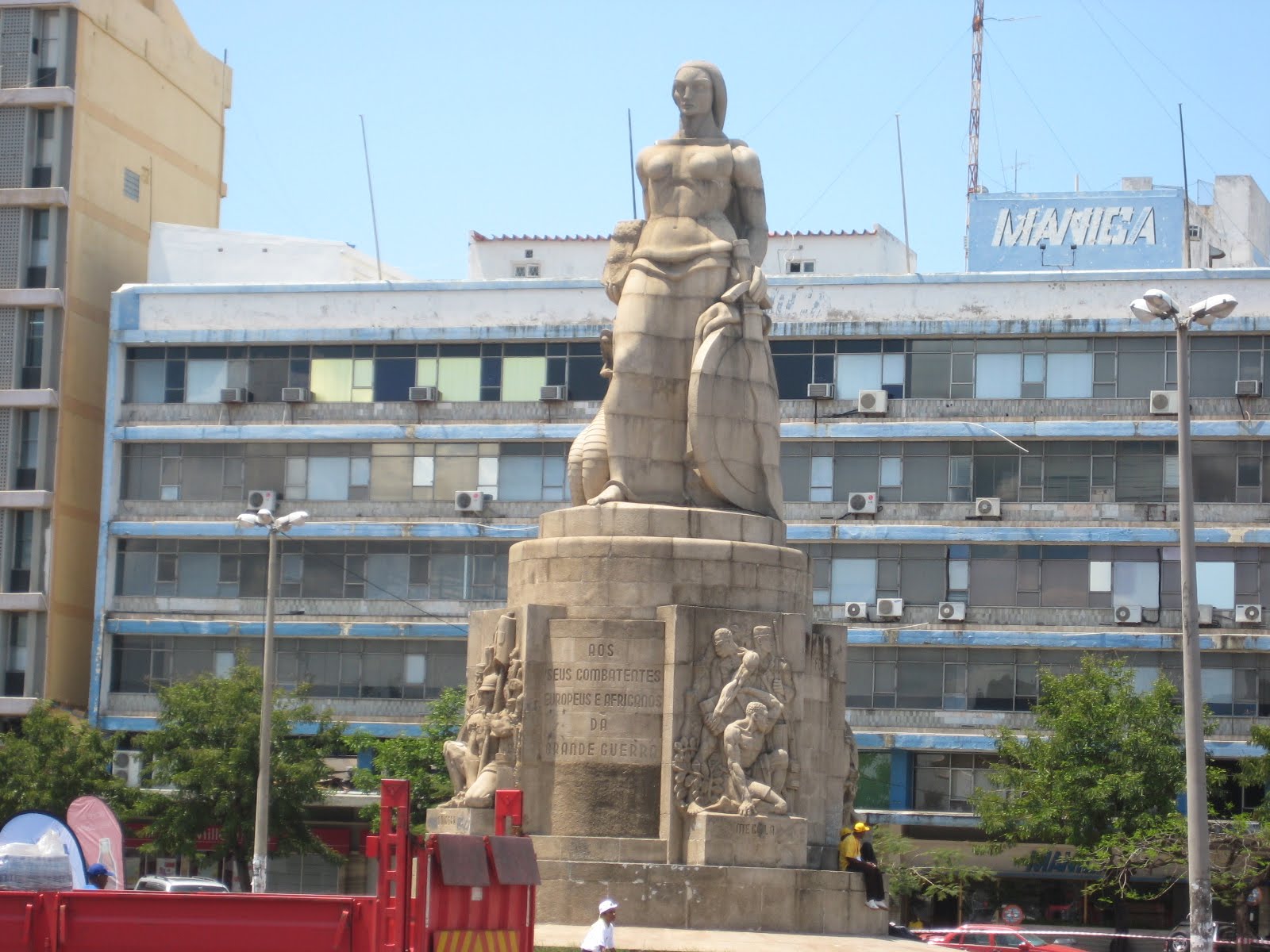
[Central Railway Station that is 100 years old. The War Memorial Statue with a woman holding a snake that she caught using a hot portige soup. But commemorates the solidies who fought at The World War I.]
[Southern Sun Hotel where we stayed ... It is facing the Indian Ocean and the scenery was panoramic.]
Kristin and I traveled to Maputo, Mozambique taking advantage of Jeffrey's trip to attend the OI Africa CEO conference held in Maputo.
We arrived on Saturday (October 16th), very late, and the next morning we discovered that we slept right at the beach. It was a pleasant surprise! Ahhh... the soothing sounds of the breaking waves.
We took the city tour on Sunday: Central Railway Station, The Iron House (designed by Mr. Eiffel who designed the Eiffel Tower in Paris, The War Memorial (interesting a woman statue holding a snake), Visit to the Central Market (We bought a lot of cashewnuts), Botanical Gardens, Cathedral. several ministry buildings.

There are three-wheeler vehicle that you can ride to take a look around the city. They are called "Tuk-Tuk." We were planning to ride it, but ours had a bad engine so we ended up using a taxi. And I forgot to take a photo.
On Monday and Tuesday, we were originally planning to visit Swaziland, but we ended up cancelling it because the costs were too high for a marginal benefit, in light of the border fees to pay to entere the Swaziland and reentrance visa fee to Mozambique, and transportation fees. So we ended up deferring it until later, hopefully.

So we relaxed quite a bit on both days, but we enjoyed the famous seafood of Mozambique every dinner. We went to Sagres, Costa do Sol and Spicy Thai. They all were wonderful! I ate a lot of delicious seafood so that I may not miss them for quite some time.

One morning at 5AM, I caught the moment of the sun rising over the horizon. As usual, it was a breath-taking and gorgeous. So here they are.
We were grateful for the opportunity to see and experience another African country. - Jeffrey

Monday, October 11, 2010

Accra, Ghana (September 2010)


[At the memorial center for Dr. Kwame Nkrumae, the first president of Ghana who led the country as part of the Pan-African vision.]

I participated in a week-long Opportunity International Africa conference that took place in Accra, Ghana, in September 2010. I had an opportunity to look around in the city of Accra, the capital city of Ghana on Friday and Saturday.

Ghana is called "the Gateway to West Africa." It is the transportation hub to many neighboring countries. It borders with Togo (East), Burkina Faso (North) and Ivory Coast (West). All neighboring countries are Francophone, but Ghana is Anglophone along with Liberia and Nigeria.
[Huge bamboo trees]
Ghanians, as they are called, are very friendly and warm people. Ghana is a safe country with political stability. But the country's weather is hot and humid since it is close to the equator and facing the Atlantic Ocean to the south.
Together with other conference participants, I walked around the Makalo Market located in the center of Accra. It has everything you need, literally. It is huge and you can be easily lost if you do not know the way around. We also visited an Art Center where you can buy many traditional souvenirs. It was full of small shops where very aggressive solicitation was rampant. We also visited the Memorian Center for Dr. Kwame Nkrumae, the first president of Ghana. He was a visionary who saw the Pan-African vision and actually shared resources to help other neighboring countries attain the state independence, such as Guinea.

On Saturday, we visited the city's Botanical Garden that was built by the British colonists 110 years ago. We saw very interesting trees, plants, flowers and vegetables.
[A ficus tree emptied by a parasyte tree. This photo was taken inside the tree towards the top.]
More than anything else, I was able to enjoy a variety of dilicious seafood that is rare delicacy in Rwanda.

Overall, it was short but sweet. - Jeffrey

Thursday, May 27, 2010

Woonlim Sanbang...(May 2010)


Huh Ryun was also called Sochi. This name, Sochi, was given by his master/teacher Choosa Kim Junghee. Choosa was one of the most famous caligrapher and painter in the Korean history. Choosa was comparing him to Daechi of China who was renowned as a painter at that time. It was a great honor for Sochi. He was one of the King's painters working at the King's palace.
After Choosa died, Sochi came down to his home town at Jindo Island and established Woolim-gak (Woolim means Cloud and Woods literally. Woolim Sanbang means Clouds and Woods and Mountain Place.) He painted, wrote and enjoyed the beauty of the nature. He showed great talents in three areas: painting, poem and caligraphy. I could see his great talent by looking at some of his work at the Exhibition Center.
Huh Ryun's artistic talent did not stop with himself. His DNA continued with his son Huh Hyung (Midang) and Midang's two sons Huh Geon (Namnong) and Huh Rim (Rimin). Noteworthy is Namnong Huh Geon. Sochi's Woolim-gak was sold by one of his grand children for mony, but Namnong bought the property back and restored the buildings as shown in the painting. Then he has donated it all to the government. Now it is one of the national treasures. Namnong made great efforts to teaching and built a memorial center, called Namnong Memorial Center, and donated it to the Mokpo City.
Huh Ryun's heritage continued beyond third generations. Huh Rim artistic greatness was short-lived because he died at 27, but before he died his paintings gained a lot of recognition from Korea as well as Japan. Huh Rim's son Huh In carried on the family's articstic DNA under Namnong's teaching. Now Huh Rim's two sons are continuing with painting.
All in all, Huh Ryun's artistic talent is flowing into five generations, probably very rare even from the world's point of view. Great achievement and great art work. I felt awesome at the talent, dedication, great work. - Jeffrey

Beautiful Korea Cholla-Namdo...(May 2010)


I have posted separate blogs on some, but Korea's Cholla-Namdo was beautiful overall. Here are some additional photos.

[Kris in front of stone sign with a well groomed tree in the background. The sign says "the spirit of Yudal mountain." It is in Mokpo City where I was born. --- something like this is all over the places.]


[Kris in front of the statue of 'Admiral Yi Soon-shin' who legendarily defeated the Japanese ships in all battles (23) during a war, called "Imjinweran." He is known to be the most respected admiral in the world's naval history. He also invented the "Turtle war ship" that was invincible to the Japanese. - Mt. Yudal, Mokpo]


[Pine trees growing on rocks. This beautiful scene is not even counted as one of the sites to have to see. - Ttanggeut maul, Haenam]
.
.
.
.
.
.
[It means "Like in the beginning." This phrase profoundly states the suggested attitude for everything we do. The description says that we should begin each day newly with an attitude like we are doing it for the first time. Like a baby bird facing the sky for the first time and a new sprout that is stepping up on the soil for the first time, even when the sun is setting, like in the morning, like in the spiring.]
.
.
[Traditional Korean house in the background. The tree in front of the house is 156 years old and it is still blossoming during the winter. - Seyoon-jung, Jindo]
.
.
.
.
.
.
[Kris and me at Sebang Nakjo. This place is known to have a beautiful sunset, but due to schedule we could not see it. In the bbackground, there were many beautiful islets. Reportedly, there are 1,400 islands/islets in the southern and western seas of Korea. Sebang, Jindo.]
.
.
.
.
[A sunset seen from the hotel room. The hotel Hyundai was built by Hyundai Heavy Industries to accommodate the engineers and buyers for the ships they are building at one of its several shipyards. Mokpo]

End of Earth in Korea...(May 2010)


[Tom to bottom and left to right: A few pine trees growing on rocks ... Kristin in front of a tombstone indicating the "end of earth" ... Kristin in front of the observation tower at the summit ... A scene from the observation tower.]
Kristin and I have been to the end of the earth ... well ... of Korea. We climbed approximately 300 meters via a mono rail and at the summit we climbed another 8 floors at the observation tower. It was hazy, so we could not see very much, but nonethless it was the end of the Korean peninsula, like the Cape of Hope in Cape Town, South Africa.

On one side, we were able to see many islands scattered around the southern and western part of the peninsula. On the other side, we were able to see the beautiful bay area where many sea lives are growing.
At this place, called "Ttanggeut-village" (meaning End of Earth Village", you could see the sunrise as well as sunset.
This place called "End of Earth" is not the End of the Earth in the bible. Nonetheless, it was an experience of the "End of Earth." - Jeffrey

Sunday, May 23, 2010

Osaka, Kyoto, Kobe, Nara in Japan...(May 2010)


[Top to bottom and left to right: The place that produced a premium sake called "Jung-jong." .... Kristin at Merican Park in front of Kobe Port Tower ... An interesting shape of Oriental Hotel at Merican Park ... An old ship used to cross the Pacific Ocean ... Kristin showing the poster for Osaka Castle ... The Osaka Castle ... The Chungsoo (meaning clear water) Temple ... The gate to enter the temple worshiping the "god of success" or Toyotomi Hideyoshi who was born to a poor farmer couple but rose to the ruler of the nation ... The street called "Dotombori" full of restaurants and snack bars ... Kristin with the Dotombori River at the background ... The Buddah Statue made of bronze housed at the Daedong Temple. (Reportedly 16 people can stand on his left palm.) ... The Daedong Temple's main building.]

Kristin and I also traveld to Osaka, Japan from May 21st through 25th, 2010. We joined a packaged tour program led by Ms. Hyunjoo Koh. She is a Korean, but her Japanese was impecable and her knowledge about Japan was impressive. She explained well and clearly about Japan's history, culture, places and people.

During this short trip, we visited Kobe, Osaka, Kyoto and Nara. These cities are full of Japan's old historic heritages and cultural treasures.

Kobe is famous for many things: i.e. its premier beef, premier sa-ke, and premier rice. They go with hands in hands. Without premier rice, they cannot make premier sa-ke and produce premier beef. We visited a traditional sa-ke producing place that is now preserved as Japan's museum. We also visited Merican Park that housed Kobe's Maritume Museum, Mosaic Walk, Kobe Port Tower etc.

Nara was the place where Japan's royal family was established, arguably by the descendents of the last King of Baek-Jae, one of three countries in Korea. Japan denies it, but one of the emperors admitted it. Again, truth prevails. The royal family lived and rulled in Nara for 500 years. In this city, we visited a Buddist temple, called "Dong-Dae-Sa." This temple was built by one of the emperors because of much contribution made by one of the Korean monks who introduced the Buddism to Japan. This temple houses one of the largest bronze Buddah scultures in the world. Reportedly, 16 men can go up on the Buddah's left palm open flat. That is pretty big...

Kyoto, literally meaning Capital City, was the city where the royal family reigned the country for 1,000 years. Kyoto has at least 20% of Japan's cultural heritages. There are many buddist temples and "Shin-sa" places. (Japan's traditional worship place for gods according to its "pan-theism.") We visited one of the famous temples, called Chung-Soo-Sa (Temple of Clear Water) that also houses a Shin-sa.

Osaka is the second largest city in Japan, next to Tokyo. It has a castle, called Osaka Castle, which is the pride of the Osaka citizens and even of many Japaneses. Kyoto is nearby and this castle was initially built by one of the greatest heroes of Japan, namely Toyotomi Hideyoshi. He was a Samurai who unified the entire country and established the central control. The most notable of him was that he was born to a poor farmer but rose all the way to the top without any parental inheritance. No wonder he is treated as a "god of success" among the Japanese. We clibled all the way up to the Chun-Soo-Gak that is located at the center of the castle and is now the castle's museum.

Now the Japan's capital city is Tokyo, literally meaning Eastern Capital.
This short trip included a rigorous travel plans, but we were grateful for just following the instructions and for all transportation, lodging and foods pre-arranged. It was a convenient travel! We had to follow the canned schedule, thus disallowing us from staying longer at places that were of more interest to us, but overall we enjoyed the packaged tour, particularly led by such a well experienced guide. Probably we will give a try again. - Jeffrey

Hong Kong (May 2010)


[Top to Bottom and Left to Right: Kristin in front of an old model Peak Tram ... A traditional scene of Hong Kong with a Duk Ling ship ... IFC II tower, the third tallest in the world ... Do I look like Bruce Lee? I did not think so... A sculture carved on an elephant ivory ... Kristin with the Sky Terrace at the peak ... A nigh scenery of Hong Kong Island one and two, watching the Symphony of Lights.]

My wife, Kristin and I made a quick trip to Hong Kong from May 18th through 20th, 2010. We stayed at Courtyard Marriott through the reward program.

This seemingly short stay was long enough to experience Hong Kong; its vitality, crowdedness, double deckers all over the narrow roads, steep hills, lush green mountains, skyscrappers in Hong Kong Island, dim sum, high tone voices of Hong Kong people, Stanley Market, strolling around Tsim Sa Tsui, tram rides, Peak Tram ride and looking out the Hong Kong Island and the Kowlon Peninsular, Star Ferry, MTR, airport express rail, foot massage, symphony of lights among the skyscrappers, change in the primary language (many people did not even speak English any more) etc.

We hoped and prayed that Hong Kong will remain an independent city country promoting free trade and inviting many business people/financial institutions from around the world. - Jeffrey

Saturday, May 15, 2010

Tae-An Peninsula (Korea) at Mother's 80th Birthday (May 2010)


[Top to Bottom and Left to Right: My parents in big laughters after exchanging "couple rings." ... All family in attendance were pictured together... The morning scene at the fishing village was quiet and beautiful ... Kristin and I were at the "Malipo" beach where we visited in 1982 before the wedding ... "Jung-Seo-Jin" means that it is the farthest western point of Korea ... Minsook, the younger of my two younger sisters is helping my parents cut the birthday cake. The little child is Eunsun, cute and smart ... The resort had a saxphone structure that added an interesting charm to the resort ... My sister, Minja and my wife, Kristin took a photo with my parent at the Malipo Beach.]

My mother's 80th birthday celebration took place at the Poonggyung Resort at Tae-An. Tae-An is a peninsula sticking out in the middle of Korea in the west, the closest point to the Mainland China. A few years ago, this place was covered with the oil spill, but it has since been restored to the current status thanks to the nationwide efforts to clean up the area. Almost all political figures and celebritieis participated in the clean-up process along with citizens, students and wives.
It was a beautiful place with a view to the Yellow Sea, which was so calm and tranquil because it has come so deeply into the inland. The ebb tide revealed the dark mud along with rocks covered by sea oysters and small crabs.

In attendence were my parents, my two sisters and the younger one's (Minsook) family and my wife. The older of the two (Minja) originally planned to have her husband and their son (Hwansuk) come, but they had to go back to Seoul after the lunch not to miss an important appointment. Since it was a 3-hour drive from Seoul, we had to pursuade him not to come all the way down.

We spent quality time together, eating a lot and playing game a lot. My mom at 80 was as young as 40 at heart and to some extent physically as well. She played ping pong with my sister and she even kicked around the soccer ball. I was so grateful for her health and strength at her age.

On Sunday, we worshiped God for His grace and provision of health until our mom reached the age of 80. Our faither was 86 years old and still going strong. Praise the Lord! Our parents exchanged their "couple rings" and cut a birthday cake. Mom looked very happy and dad looked joyous.

Korean rural areas looked so nice and neat that I was so impressed. It has been a remarkable improvement over the past several decades. Even the roads were well constructed and maintained so clean. God has been gracious to Korea and I prayed that Korea may continue to be under His gracious care. - Jeffrey