Sunday, April 13, 2014

Trip to Jordan... (February 2014)

Like Bodouins at Wadi Rum
Kristin and I traveled to Jordan, a small but safe and stable country in the Middle East. It borders with Israel but has signed a peace agreement years ago, which remains in effect. It also borders with Syria and these days, Jordan has received more than one million refugees, which is a significant number in light of Jordan's total population of less than seven million. Nonetheless, Jordan is receptive to helping the neighboring countries.

Jordan is a melting pot culture. It is a biblical site full of names and places that appear in the bible. These include Mt. Nebo where Moses looked over the promised land, but could not enter, Dead Sea of course, Jordan River that flows from Lake Galilee to Dead Sea, Jerash or Gerash where Jesus expelled a host of ghosts to enter into a herd of pigs. This land used to be inhabited by Edomites, Ammonites, Moabites. Later, Nabbateans lived and dominated in the region, thus creating the massive and impressive Petra, the lost city or the rose-red city, full of architectural sculptures carved on sandstone mountains. Roman theaters are in Amman and Jerash. Greek temples and Roman temples coexist while Christian heritages are also evident. Many places show the mixed culture of the local, Roman, Greek empires and Christian influences. Jordanians must have been very adaptive and embracing.

Jordan is famous for Petra. Petra means a feminine form of rock in Greek. (Compare it to Petro for Peter.) Petra is a lost city which was discovered by a Swiss explore in 19th century. It has a lot of architectural sculptures carved on sandstone mountains all over the place. This city used to be occupied by the native people, called Nabbateans. They were bedouins, or people living in the tents moving around in the deserts. They dominated the region with caravan trades for quite some time, but finally conquered by and annexed to the Roman Empire. And the natives extinguished. Almost.

The current Jordanians are composed of various people groups. The majority is Palestinians. Hundreds of years ago, they settled in this area and live peacefully. Even the current queen is a Palestinian. But if you go back a little further, their ancestors are all the same people.

Jordan does not produce oils or have rich minerals. Its main FX earning industry is tourism. Obviously the main attraction is Petra, probably 90%. The rest includes Dead Sea and recently Jerash that is attracting tourists with archaeological sites full of ruins of different ages. Jordan also produces pomogranates and olives.


Mt. Nebo is a place where Moses looked over the promised land and died. It is almost a hill but it carries a significance because of Moses. A cross with a bronze snake illustrates the miracle in the Old Testament,  symbolizing the death of Jesus Christ on the cross later on. On the way, we visited a castle that was used by the colonialists, primarily to defend themselves against the attacks from the local indigenous people.


Petra was enormous and impressive. The famous Treasury was obviously beautiful and almost inspirational, but there were lots of other architectural sculptures carved on sandstone mountains. I managed to climb all the way to Monastery that is another 50 meter by 50 meter structure, gigantic although lacking some details evident on the Treasury.  The lookout places at the Western edge over the Wadi Araba, the valley towards Dead Sea and Israel, was jaw-dropping. It was like Grand Canyon. Not quite but close enough.

Camels, donkeys, mules and horse carriages were attracting tourists who prefer not to walk too long or not to climb the steps to higher places, such as Monastery, the Higher Altar, Royal Tombs etc. We managed to climb all the way to Monastery.

The gorge or pathway from the entrance to the Treasury was just fabulous. Particularly, the night sky covered with countless stars during the Petra by Night was gorgeous and almost mystic.


Mosaic art is Jordan's pride. Jericho's tree of life made of stone-mosaic art showed a cycle of eco system. Also vases and plates were made of mosaic-looking art, but in fact ceramic work. They make plates, table tops, chairs and wall-hanging decorative art pieces with this mosaic art. Jordan has the oldest mosaic art pieces in St. George Church, a Greek Orthodox Church in Madaba.


Wadi Rum is an impressive place. This is where the movie "Laurence of Arabia" was filmed. Coincidentally, the main actor Peter Otool passed away several months ago. We did a two-hour jeep tour (desert safari) in this canyon-like desert that is filled with red rocks and mountains. I tried to dress like Bodouins, the nomadic people of Arab while we were visiting one of their tents.


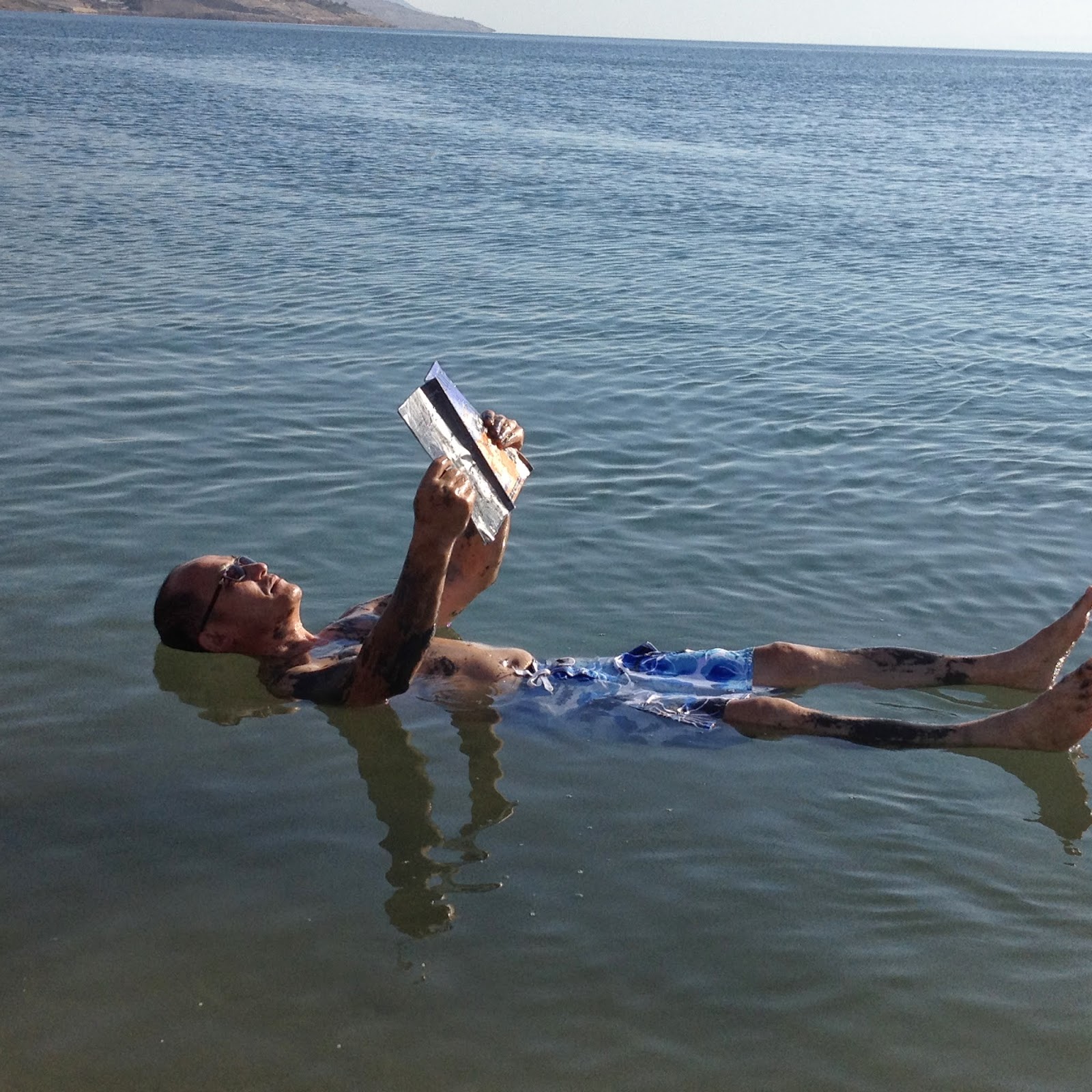
Dead Sea is an unforgettable experience. Because of high salt contents, this lake is extremely salty. It is the lowest dry point on earth, approximately 400 meters below the sea level. It receives water from Jordan River and does not flow anywhere. It only evaporates, thus ending up with high quantify of salt. You do not need to know how to swim. You cannot sink or drown here. You just float. The soils contain rich minerals and thus produce good cosmetic or bathroom goods. I tried the mineral-filled mud on my body and floated on the Dead Sea pretending to read a magazine.

Historically rich Jordan. We have not been able to explore the country to the full extent of satisfaction, but it has been a wonderful experience of making the bible come alive with visible evidences of certain sites. - Jeffrey

Sunday, December 29, 2013

Trip to Senegal (December 2013)...

Kristin and I traveled to Senegal in December 2013. The primary purpose was to see Joyce who is serving as Peace Corps volunteer based in Thies, the third largest city in Senegal.

Senegal is in West Africa. Its land is 197,000 sq. km. and its population is approximately 13 million. Senegal has another country squeezed into it, namely The Gambia.

We arrived in Dakar, the capital city located at the western tip of the country, and stayed there for four nights. We visited several places, including Goree Island, French Institute, vegetable market, fabric market, Independence Plaza, Sea Plaza, Monument of African Renaissance, Seoul Restaurant, Presse Cafe, Time's Cafe, an art gallery, International School of Dakar and Ngor Beach.

Goree Island was the capital for slave trade in West Africa. It was a gathering place for all slaves collected from all over in West Africa before they were shipped to North America, South America or Europe. This Goree Island was compared to Zanzibar that was the capital for slave trade in East Africa.

The visit to the Monument of African Renaissance was quite an experience. It is the tallest statue in the world and it cost the country $27 million. This statue of a father holding his wife and holding up their baby pointing to a bright future, leaving behind the tragic past history of colonization and slavery. Ironically, the mother's skirt was completely untraditional to Senegalese culture and far too short, thus becoming very scandalous. Moreover, their faces were not like Senegalese. Another observation that I made was the baby was pointing to the direction to North Korea, while the guide was explaining that the baby was pointing at America. American was in their back. No wonder it is scandalous.

Africa pulled by other powers

Creative art by a Senegalese artist

Baobab Tree 150 years old at Goree Island

Popenguine Beach scene

Rice with chicken shared by the Ly family

Enebe Guest House at Popenguine

Flamingo scultures at Popenguine Beach

Christmas Service at International Fellowship Dakar

Heavenly scene at a restaurant in Popenguine


Almost junkie van... most of the cars were like this

The living room at the Ly's

Monument of African Renaissance

Fantastic ocean view at Ngor Restaurant

Quality time between mother and daughter

A sunset at Popenguine Beach

Another sunset

Riding a horse wagon at Thies

Statue of returned slaves

Street arts at Goree

Street vendor

Waves were gorgeous
The lunch at Ngor Beach was gorgeous. The food was excellent but we enjoyed the soothing sounds of ocean waves more than the food. The restaurant's decorations were quite interesting.

We then traveled to a small beach town called Popenguine probably with a population of one thousand. But the beach was stunning and people were so friendly. We stayed two nights at a guess house called Enebe that had four rooms in a cute and cozy setting. We thoroughly enjoyed the ambiance and the hospitality of the guest house.

Joyce and I climbed to the top of the cliff by the beach and on the way down we saw a beautiful sunset.

The restaurant by the beach was a fantastic experience. The setting was beautiful and the ambiance was a dream with the soothing sounds of breaking ocean waves. We had a lunch on Christmas Eve and it would be an unforgettable memory.

On Christmas Day, we traveled to a more touristic town called Sally. Joyce wanted to experience the sauna and facial treatment at an award-winning hotel and spa, called Rhino Resort Hotel and Spa. It was a five-star hotel, but it was obvious that they over-advertised themselves. On the way there we saw a numerous bill boards, but the actual place was not so grand nor luxurious. Kristin and Joyce had experiences at the spa, while I was enjoying my solitude moments without disruption. The lunch was far better than the hotel experience itself.

Joyce and I learned about how to play a card game, called PK, and we enjoyed playing games for three nights.

After Popenguine, we traveled to Thiess where Joyce is living and working. We stayed at a hotel called La Massa, supposedly one of the better hotels. We visited the family of the Ly. Madam Ly was Joyce's business counterpart. Joyce has been helping Madam Ly's jewelry business in market development, product design and accounting. The family invited us to lunch and we ate Senegalese traditional rice with chicken. The food was delicious but their family's hospitality was wonderfully warm and friendly. Madam Ly's husband was Samba Ly and he was a painter. They have nine children and three of them were artists. We saw some artworks and they were very unique and creative. The father Samba Ly gave us one of his oil paintings as a gift. A lovely family we enjoyed dearly.

We briefly visited Joyce's living place. A moderate place it was. I prayed for Joyce over there asking for God's special grace of protection and safety over the remaining four months or so period until she will have completed her service period with Peace Corps.

We also visited American Corner located at the Cultural Center. Joyce is teaching English once a week. Also, we stopped by Peace Corps Training Center where new Peace Corps volunteers must be trained for two months. It is the only one in West Africa.

The following day, we visited Ibu, a farmer, and his farm where Joyce is working on a chicken farm project. Ibu is a well respected community leader and also an exemplary farmer with several best practices of farming. He was growing many veggies with water dripping irrigation system. Joyce has just received approval to raise a funding to build a chicken house to be able to raise up to 500 chickens. Joyce hopes to finish the project before her tenure is over. Ibu was father of four children. We visited his house briefly. Ibu was a very warm and nice man, who was willing to help out his village people going beyond the boundary.

We headed off to the airport to catch the return flight to Kigali Rwanda. We used taxies several times, but Senegalese taxis were very close to junkies frequently with window shields severely cracked and the car seats were wildly torn. All taxis we rode had the odometers and speedometers out of order. It was a miracle that such cars were still running. Comparatively speaking, Rwandan taxis are fancy and luxurious limousines.

Both Kristin and I came back home safely with deep gratitude for the opportunity to see Joyce and spend time together over Christmas. For me, Senegal was the 12th country to visit in 2013. - Jeffrey 

Saturday, December 14, 2013

Trip to Nairobi, Kenya (November 2013)...

Trip to Nairobi, Kenya (November 2013)...

James Lee, Mrs. Lee, Caleb Kim, Mrs. Kim, Kristin
I serve as a member of Opportunity Kenya's board. So I travel to Nairobi, Kenya once a quarter.

In November, there was a board meeting and Kristin joined me in this trip to Nairobi for a few days. The hotel we stayed was House of Waine in Karen, a boutique hotel with 11 bedrooms converted from a private home. The surrounding was cozy and beautiful, and the staff service was just excellent. Many honeymooners come for an experience. We also had an opportunity to stay there.

Kristin spent time with Manok Kim, a Korean missionary Dr. Caleb Kim's wife for two days. Caleb is a professor at Africa International University which converted from a theological seminary in recent years. He teaches Anthropology with the focus on Islam cultures. He directs the doctoral program in Intercultural Study in cooperation with Fuller Theological Seminary in Pasadena, California. He has been serving in Kenya and a couple of other East African countries for the past twenty five years.


Kristin happy at Haru Japanese Restaurant
After the board meeting, Kristin and I were invited to lunch at Dr. James Lee's house, along with Caleb's couple. James is another Korean missionary who is running Bridgewood College where they teach and train pastors and young workers about bibles and related topics. They issue diplomas to them after completion. They have served in Kenya for the past 15 years or so.

Both Caleb and James were involved in Integral Mission Alliance of which I was also part two to three years ago. They are intellectual scholars, passionate missionaries, like-minded fellow Kingdom workers for holistic mission and more than anything else good friends. I was very grateful for the opportunity to fellowship with them before we left to come back to Kigali, Rwanda. - Jeffrey